
Sensory & motor development
Supporting Fine Motor Skills and Hand Strength in Children
Fine motor skills are the small, precise movements of the hands and fingers that children use to eat, dress, play and eventually write. They build on a foundation of core and shoulder stability, hand strength and sensory feedback — so the most effective practice is often play, not worksheets.
Last reviewed · Educational information only
How grasp develops
Pencil grasp usually progresses through predictable stages. Ages are approximate and children vary.
| Grasp | What it looks like | Approximate age |
|---|---|---|
| Palmar-supinate (fisted) | Crayon held in a fist, movement from the shoulder | 1 to 2 years |
| Digital-pronate | Palm down, fingers pointing toward the paper, movement from the elbow | 2 to 3 years |
| Static tripod / quadrupod | Thumb and fingers hold the pencil, movement still from the wrist and arm | 3½ to 4 years |
| Dynamic tripod / quadrupod | Small finger movements control the pencil | 4½ to 6 years |
Research suggests that several mature grasps, including the dynamic quadrupod, can be equally functional for handwriting speed and legibility. Comfort and endurance matter more than a perfect textbook grip.
The building blocks of fine motor control
Postural stability
A stable trunk and shoulder let the hand move freely.
Hand strength & arches
Small hand muscles shape the palm for controlled grasp.
Pincer grasp
Picking up small items between thumb and index fingertip.
Bilateral coordination
One hand stabilizes while the other works — like holding paper while cutting.
In-hand manipulation
Moving objects within one hand, such as turning a coin.
Visual-motor integration
Guiding hand movements with the eyes, as in tracing and copying.
Play-based activities by skill
Hand strength
- Squeezing play dough or therapy putty to find hidden beads
- Using spray bottles to water plants
- Tearing paper for collage
- Wringing out sponges at bath time
Pincer grasp & precision
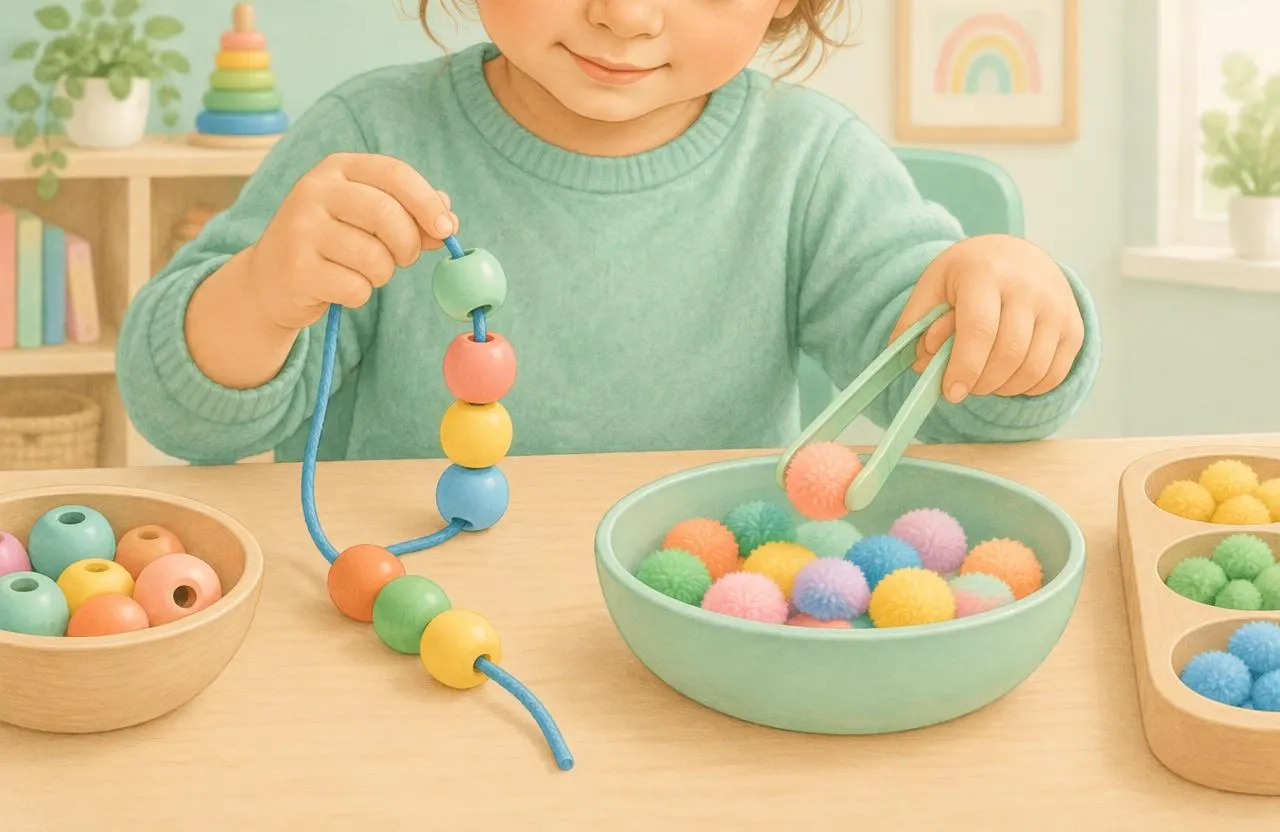
- Picking up cereal pieces or pom-poms with fingers or tongs
- Putting coins in a piggy bank
- Peeling stickers
- Placing pegs in a pegboard
Scissor skills
- Snipping straws or strips of card
- Cutting play dough snakes
- Cutting along thick straight lines, then curves
- Use the thumbs-up cue: thumb on top, elbow close to the body
Handwriting readiness
- Drawing on a vertical surface such as an easel or chalkboard
- Short crayons or broken chalk encourage a finger grasp
- Copying vertical, horizontal and circular lines before letters
- Lacing cards and threading beads for bilateral coordination
When to seek advice
Consider an occupational therapy evaluation if your child strongly avoids fine motor tasks, tires very quickly, is significantly behind peers with self-care, or if handwriting difficulties are affecting schoolwork despite practice.
Child development tips, in your inbox
Practical, plain-language guidance on milestones, sensory needs and school support. No spam; unsubscribe anytime.